
NSW incentives · 23 Aug 2026
NSW PDRS BESS4 & BESS5 — commercial battery certificates from 1 September 2026
From 1 September 2026 NSW farms and businesses can create Peak Reduction Certificates on a behind-the-meter battery. Stack PRCs on STCs. Book the site visit now.
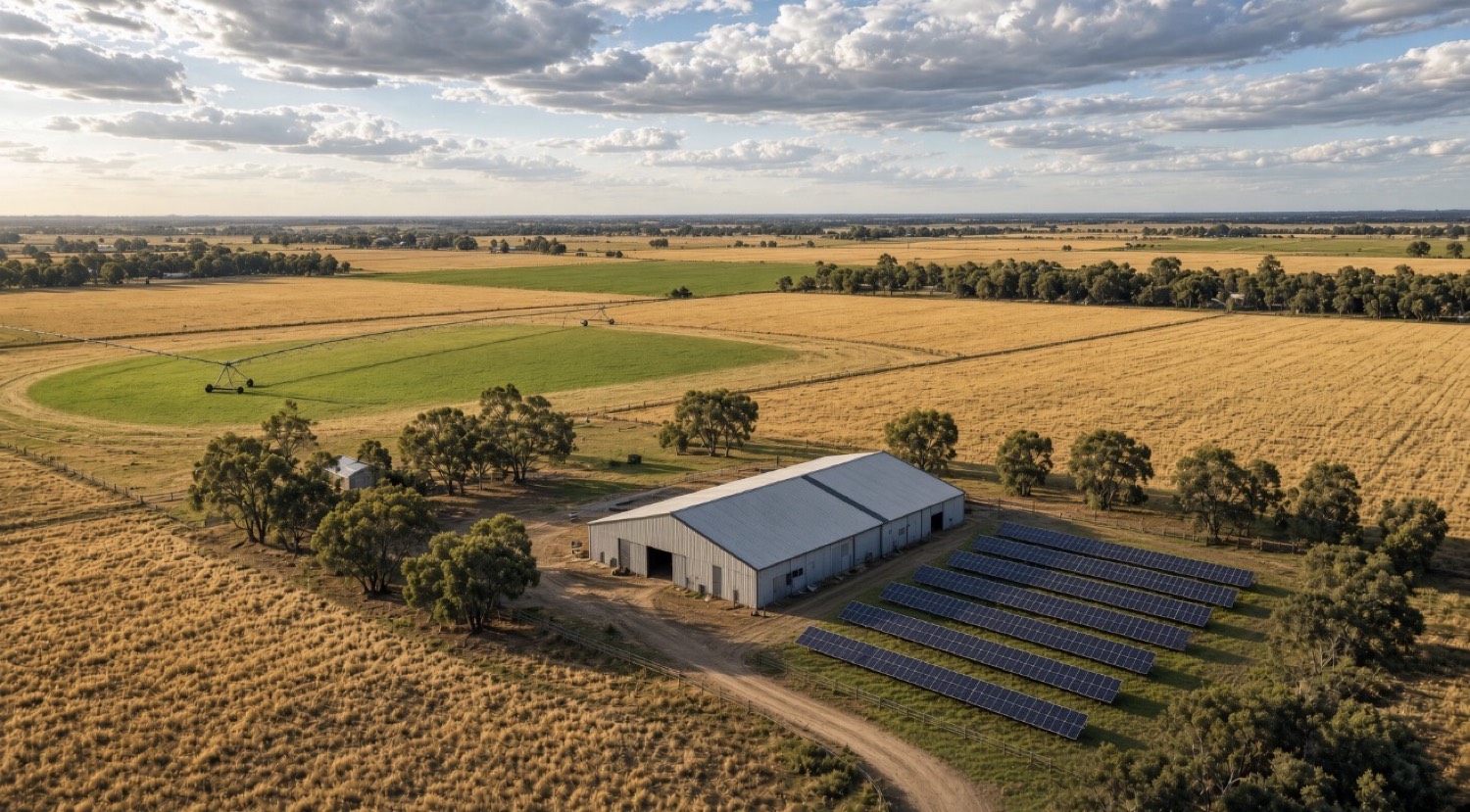
Until now the NSW Peak Demand Reduction Scheme was mostly a household and small-battery story. From 1 September 2026 that changes. Three new activities — BESS3 (apartments), BESS4 (small and medium business) and BESS5 (commercial and industrial) — let eligible NSW sites create Peak Reduction Certificates (PRCs) on a new behind-the-meter battery.
For the farms, sheds, workshops and light industrial sites we actually install in Moama, Deniliquin, Finley and Mathoura, BESS4 and BESS5 are the ones that move the number. BESS4 covers usable capacity more than 20 kWh up to 200 kWh. BESS5 covers more than 200 kWh up to 30 MWh, with certificates calculated on the first 10 MWh. Usable capacity is typically 90% of the nameplate.
PRCs are not a fixed government cheque. They are market-traded certificates, the same family of idea as STCs and ESCs. Electricity retailers have to surrender them against a peak-demand target, so the certificates have a price. That price moves. Anyone printing a frozen “$X off your battery” on a Facebook ad is guessing. We model current certificate value against the actual battery, inverter, network loss factor and whether new solar is sitting next to it — then we put that in the written quote.
The stack is the whole point. Federal STCs still come off eligible solar. PDRS PRCs come off the battery. On some BESS4 systems at or under 100 kWh, the federal Cheaper Home Batteries Program / battery STCs may also apply. Pairing new solar with the battery usually creates more PRCs than a battery-only job, because the methodology rewards demand shifting when generation is on site. Solar is not always mandatory — but it is often the higher-ROI design.
This is not a set-and-forget rebate form. The battery has to be internet-connectable and controllable by a demand-response aggregator. BESS4 needs SAA-accredited install and CEC-listed equipment. BESS5 needs UL9540A fire-safety testing. Planning approval (CDC or DA) sits in front of certificate creation. A minimum customer co-payment applies on BESS4 (currently $5,000). The site cannot have already claimed BESS4 or BESS5, and it cannot be a dwelling or a data centre.
Installations must be on or after 1 September 2026. That is why we want the site visit now — not on 1 September. Paddock access, three-phase, switchboard, usable capacity and whether the array belongs on the roof or in the ground all have to be locked before the certificates are worth modelling. Victorian sites (Echuca, Shepparton, Rochester) do not get PDRS. Border meters get checked, not assumed.
If you run a pump, a cold room or a workshop on the NSW side of the Murray and you have been waiting for the commercial battery incentive to exist: it does, from 1 September. Leave a mobile. Ask for Brooke or Lachie. We will tell you whether BESS4 or BESS5 is the activity, what STCs still do, and what the stack does to payback — in writing, for your site.
Want this modelled on your roof?
We’ll size the system and stack the rebates for your roof.
Get a quote